AI Identification
Anopheles
100%
ANO
✓ Verified
ai_vision
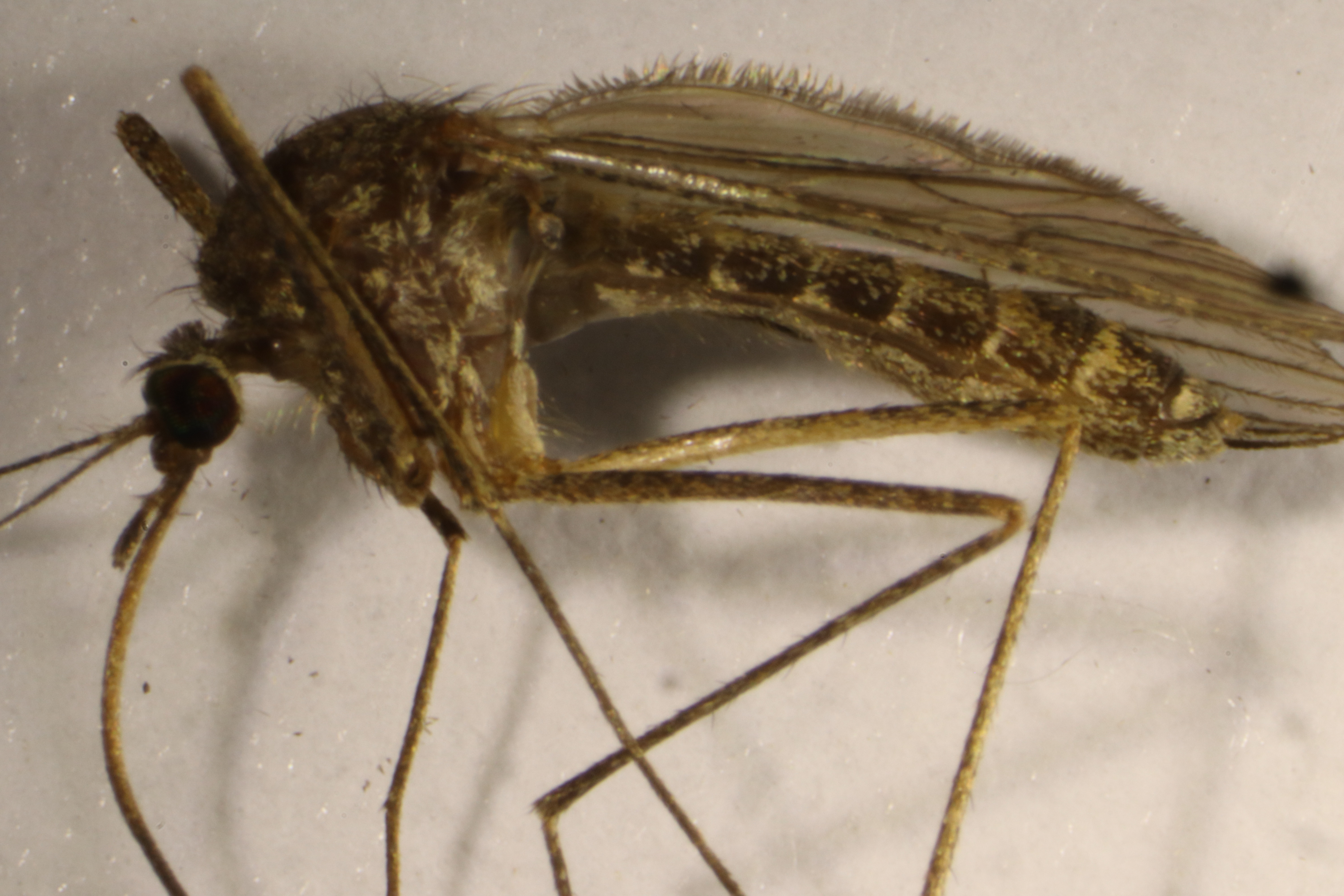
The most diagnostically significant feature visible is the palp length, which appears approximately equal to the proboscis length — the single most reliable character for Anopheles females. The wings show what appears to be a mottled or spotted pattern with alternating dark and pale scale patches along the costal margin and wing surface, consistent with Anopheles spotted-wing morphology. The scutum appears uniformly dark brown without lyre-shaped or contrasting silver stripes, ruling out Aedes s.s. The abdomen shows dark dorsal tergites with some pale banding. Leg patterning is somewhat visible with pale/dark contrast on femora and tibiae but lacks the crisp black-and-white banding of Aedes. The body appears to be at a somewhat flattened resting posture. Species-level identification is not possible from this image due to the specimen being partially damaged (scale loss), and the image resolution/angle does not allow clear examination of wing spot patterns or scutal setae needed for species determination. Genus-level assignment to Anopheles is made with moderate-high confidence based on palp:proboscis ratio and general habitus.
Model: claude-sonnet-4-6
• 95 Apr 2026
Specimen Biology
| Life Stage | adult |
| Condition | good |
Collection Data
| Site | bfs |
Preservation & Curation
| Preservation | dry pinned |
Imaging
| Body Part Imaged | whole body |
Researcher Notes
The most diagnostically significant feature visible is the palp length, which appears approximately equal to the proboscis length — the single most reliable character for Anopheles females. The wings show what appears to be a mottled or spotted pattern with alternating dark and pale scale patches along the costal margin and wing surface, consistent with Anopheles spotted-wing morphology. The scutum appears uniformly dark brown without lyre-shaped or contrasting silver stripes, ruling out Aedes s.s. The abdomen shows dark dorsal tergites with some pale banding. Leg patterning is somewhat visible with pale/dark contrast on femora and tibiae but lacks the crisp black-and-white banding of Aedes. The body appears to be at a somewhat flattened resting posture. Species-level identification is not possible from this image due to the specimen being partially damaged (scale loss), and the image resolution/angle does not allow clear examination of wing spot patterns or scutal setae needed for species determination. Genus-level assignment to Anopheles is made with moderate-high confidence based on palp:proboscis ratio and general habitus.